
Unlock 46+ Klaviyo systems, resources, and SOPs (100% free!)
Grab the exact systems and SOPs we use with our clients you can apply to your own store. This includes:


And much much more…

Blog
In-Depth Resources On How To Grow Your Business With Klaviyo
What Lifecycle Marketing Looks Like at $100M Scale
What Lifecycle Marketing Looks Like Inside a $100M Ecommerce Brand
Every ecommerce founder wants to build the next $100 million brand.
But very few people ever get to see what actually happens behind the scenes once a company reaches that level.
After working with hundreds of ecommerce brands including companies like Colgate, Momofuku, and several brands that have gone on to successful acquisitions I've noticed a clear pattern.
The brands that successfully scale don't just send better emails.
They build systems.
They create dedicated lifecycle marketing teams. They treat customer retention as a business function, not simply another marketing channel.
Here's what that actually looks like.
We turned this entire process into a full resource. It’s free. Grab the link at the end of this post.
The Goals of a High-Performing Lifecycle Marketing Team
At a growing ecommerce brand, lifecycle marketing isn't measured by how many emails get sent.
It's measured by business outcomes.
The best lifecycle teams are focused on three objectives:
Generating consistent revenue every day through email and SMS
Shipping campaigns on time while continuously improving performance
Building systems that eliminate chaos as the business scales
At this stage, founders are no longer approving every email.
They're focused on larger initiatives like expanding into retail, entering new markets, preparing for acquisition, or becoming the category leader.
Lifecycle marketing becomes the responsibility of dedicated CRM or retention teams whose job is to create predictable revenue and customer growth.
The Three Stages of Ecommerce Growth
Not every business requires the same lifecycle strategy.
What works for a $2M brand won't work for a $100M brand.
Stage 1: Entrepreneurial & SMB (Under $10M)
Early-stage brands are usually founder-led.
The team is small, resources are limited, and one acquisition channel often Meta Ads or influencer marketing drives the majority of growth.
Lifecycle marketing focuses on fundamentals:
Pop-ups
Welcome flows
Abandoned cart emails
Post-purchase sequences
Win-back campaigns
Basic campaign calendar
The objective is simple:
Create a system that generates revenue every day.
Stage 2: Mid-Market ($10M–$100M)
This is where lifecycle marketing becomes its own department.
Brands begin hiring:
Director of CRM
Director of Lifecycle Marketing
Retention Manager
CRM Specialists
At the same time, other departments become more specialized:
Product & Merchandising
Data & Analytics
HR
Retail & Wholesale
Amazon
Customer Experience
Lifecycle marketing is no longer "just email."
It becomes the central hub connecting all of these teams.
Stage 3: Enterprise ($100M+)
Enterprise brands introduce another layer of complexity.
Lifecycle teams now support:
International markets
Multiple business units
Retail partners
Large internal teams
Compliance
Multiple agencies
The CRM team evolves into one of the primary sources of customer intelligence across the organization.
Lifecycle Marketing Becomes the Brain of the Business
One of the biggest mindset shifts happens as brands scale.
Small brands think lifecycle marketing is about sending campaigns.
Large brands understand it's about managing customer data.
The best lifecycle teams constantly feed insights into:
Paid media
Product
Customer support
Creative
Merchandising
Leadership
Instead of reacting to requests, they're proactively surfacing opportunities across the business.
Understanding the Customer Journey
Regardless of size, every ecommerce brand is trying to move customers through the same progression:
Traffic → Prospect → First Purchase → Repeat Purchase → VIP → Brand Advocate
Along the way, some customers become:
Unengaged subscribers
Lapsed customers
Churn risks
Lifecycle marketing exists to move customers forward while recovering those who fall behind.
Interestingly, the biggest opportunity usually isn't hidden inside advanced segmentation.
It's improving the first two transitions:
Turning more prospects into first-time buyers
Turning more first-time buyers into repeat customers
For most brands, those two improvements generate the largest increase in customer lifetime value.
What Systems Every Growing Brand Needs
As brands mature, lifecycle marketing expands far beyond a few automated flows.
Foundational Systems
Every growing ecommerce business should have:
High-converting signup forms
Welcome series
Abandoned cart automation
Post-purchase flows
Win-back campaigns
SMS integration
Proper tracking
Healthy deliverability
These systems create consistent revenue with minimal manual effort.
Campaign Operations
Scaling brands also build predictable campaign processes.
That includes:
Shared campaign calendars
Consistent send schedules
Audience segmentation
Performance reporting
Cross-functional approvals
Instead of sending campaigns whenever someone remembers, campaigns become part of an operational system.
Journey Mapping Unlocks Better Automation
Once brands have enough customer data, they stop asking:
"What flow should we build next?"
Instead they ask:
"How do customers actually buy from us?"
Journey mapping looks at:
Top-performing products
Purchase order
Time between purchases
Landing pages
Traffic sources
Customer behavior
Only after understanding the journey do brands begin introducing more advanced automations like:
Upsell flows
Refund recovery
Category-specific sequences
Loyalty campaigns
Subscription automation
Referral programs
Wishlist reminders
Direct mail integration
Rather than building more flows, they're building smarter flows.
Campaigns Become More Sophisticated
Scaling brands also evolve beyond generic promotional emails.
Instead of relying on discounts alone, they introduce:
Product education
FAQs
Customer stories
Product launches
Seasonal campaigns
Social proof
Collection spotlights
Cross-sell campaigns
Segmentation becomes significantly more advanced as well.
Brands begin sending campaigns based on:
Acquisition source
Product purchased
Customer cohorts
Shopping behavior
Engagement level
Purchase history
Every campaign becomes more relevant because it's built around customer context.
Reporting Evolves Beyond Email Revenue
One of the biggest differences between small brands and large brands is how they measure success.
Early-stage businesses often track:
Email revenue
Open rate
Click rate
List growth
SMS revenue
High-performing lifecycle teams monitor much deeper business metrics, including:
Customer Lifetime Value (LTV)
Cohort performance
LTV
Revenue per recipient
Profit per visitor
Holdout testing
Customer retention
Repeat purchase rate
Their reports don't just explain what happened.
They help leadership decide what to do next.
Systems Matter More Than Individual Campaigns
As brands scale, operational efficiency becomes just as important as marketing strategy.
The best lifecycle teams develop documented systems for:
Launching campaigns
Building new flows
Running A/B tests
Creating reports
QA processes
Weekly meetings
Quarterly planning
These operating systems reduce bottlenecks and allow teams to execute consistently without relying on individual contributors.
Why Email Design Systems Matter
Many ecommerce brands eventually hit a bottleneck that has nothing to do with strategy.
It's production.
When you're sending 20–30 campaigns every month, endless design revisions become expensive.
Leading brands solve this with an Email Design System (EDS).
Instead of designing every email from scratch, they establish reusable templates, design rules, and approved components that allow campaigns to move quickly while maintaining brand consistency.
The result is faster production, fewer delays, and more predictable execution.
The Best Lifecycle Teams Think Beyond Email
Perhaps the biggest lesson from working with $100M+ ecommerce brands is this:
Lifecycle marketing isn't really about email.
It's about managing the customer relationship across the entire business.
The best teams influence acquisition, retention, merchandising, customer support, analytics, product strategy, and leadership.
They don't simply send campaigns.
They build systems that help the entire business make better decisions.
Final Thoughts
Reaching $100 million in ecommerce revenue doesn't happen because a brand has one perfect welcome flow or a few high-performing campaigns.
It happens because every part of the customer journey is supported by repeatable systems.
Foundational automation becomes operational excellence.
Operational excellence becomes customer intelligence.
And customer intelligence becomes a competitive advantage.
If you're serious about building a category-leading ecommerce brand, lifecycle marketing should evolve from a marketing channel into one of the most strategic functions inside your business.
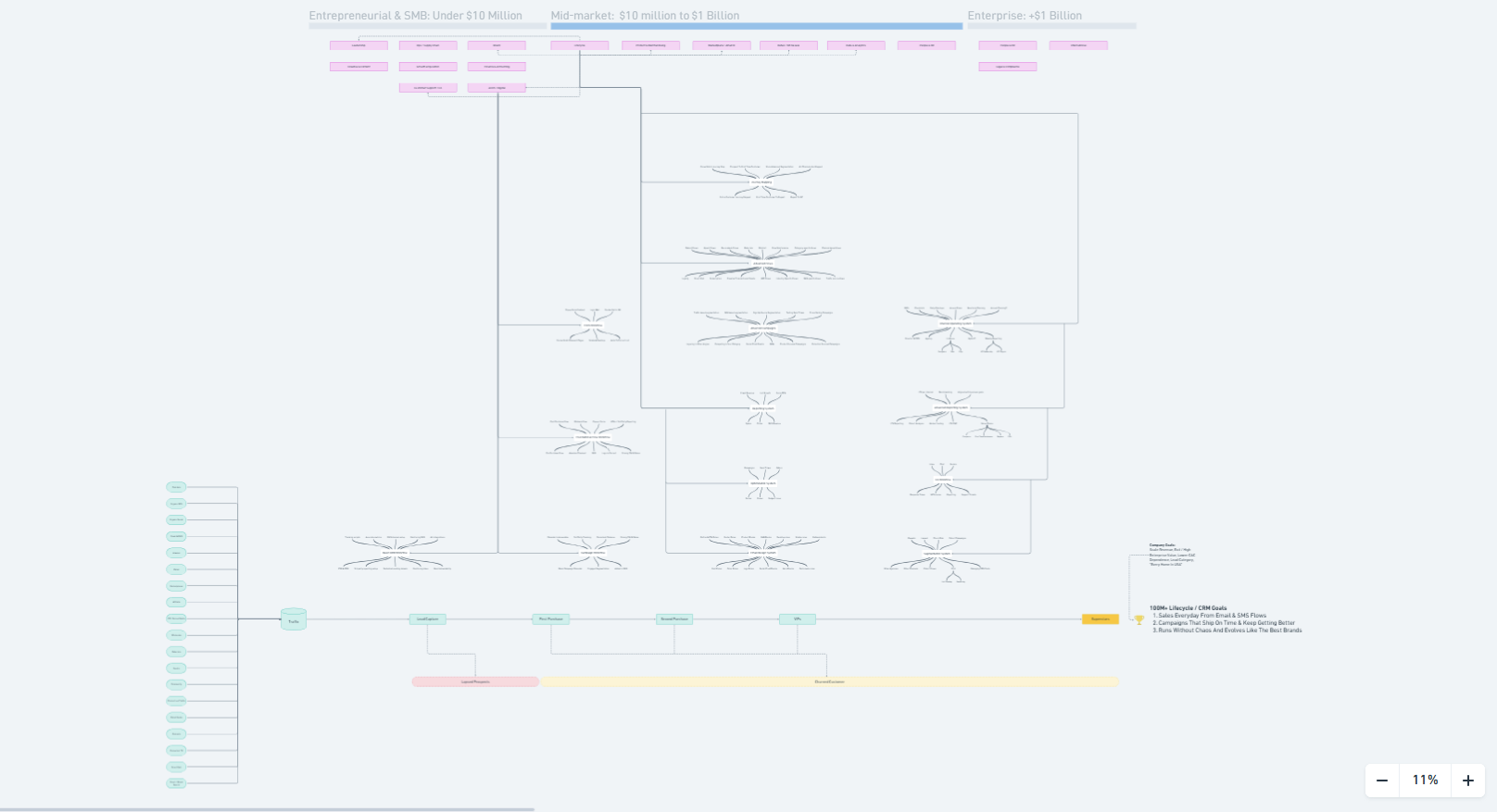
Want the exact framework? We built a done-for-you Flow Map. Download it free right here.
Need Help Implementing This For Your Brand?
The system in this guide is the one we actually use at FlowCandy to run email strategy for DTC brands, and it didn't come from a tutorial. It came from building it, breaking it, and figuring out exactly where to improve.
If you want help setting this up for your brand or your clients or you're just curious what a fully systemized email program looks like from the inside, we'd love to talk. Book a strategy call with FlowCandy

Join the Newsletter
Subscribe to get our latest email marketing guides
We won't send you spam. Unsubscribe at any time


